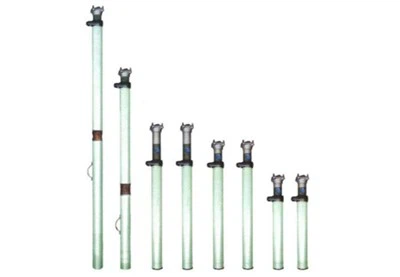

Hey there! As a supplier of hydraulic props, I'm super stoked to share with you all about how these nifty devices work. Hydraulic props are a big deal in a bunch of industries, especially in mining and construction. They're used to support loads and keep things stable, which is crucial for safety and efficiency. So, let's dive right in and explore the working principle of a hydraulic prop.
The Basics of Hydraulic Props
First off, what exactly is a hydraulic prop? Well, it's a mechanical device that uses hydraulic fluid to generate force and support heavy loads. Think of it like a super-strong pillar that can be adjusted to different heights and withstand a whole lot of pressure. Hydraulic props are made up of a few key components: a cylinder, a piston, a hydraulic fluid, and some valves.
The cylinder is like the outer shell of the prop. It's a strong, hollow tube that holds the hydraulic fluid and the piston. The piston is a movable part that fits inside the cylinder. When the hydraulic fluid is pumped into the cylinder, it pushes the piston up, creating a force that can support a load. The valves are used to control the flow of the hydraulic fluid in and out of the cylinder.
How Hydraulic Props Work
Now, let's get into the nitty-gritty of how hydraulic props actually work. The process starts with the hydraulic fluid. This fluid is usually a special type of oil that's designed to be incompressible and have good lubricating properties. When the prop is in use, the hydraulic fluid is pumped into the cylinder through a valve.
As the fluid enters the cylinder, it fills the space below the piston. Since the fluid is incompressible, it creates a pressure that pushes the piston up. The piston is connected to a load-bearing part of the prop, like a cap or a base. As the piston moves up, it raises the load-bearing part, providing support for the load.
To adjust the height of the prop, more or less hydraulic fluid can be pumped into the cylinder. If you want to raise the prop, you pump more fluid in. If you want to lower it, you release some of the fluid through another valve. This allows the prop to be easily adjusted to different heights, making it very versatile.
The Role of Hydraulic Pressure
Hydraulic pressure is the key to how hydraulic props work. Pressure is defined as force per unit area. In a hydraulic prop, the force is created by the weight of the load that the prop is supporting. The area is the cross-sectional area of the piston.
According to Pascal's principle, when pressure is applied to a confined fluid, the pressure is transmitted equally in all directions. This means that when the hydraulic fluid is pumped into the cylinder, the pressure is evenly distributed throughout the fluid. As a result, the force created by the pressure is also evenly distributed on the piston, allowing it to support the load effectively.
The amount of force that a hydraulic prop can generate depends on the pressure of the hydraulic fluid and the area of the piston. The higher the pressure and the larger the piston area, the more force the prop can produce. This is why hydraulic props are often used in applications where heavy loads need to be supported.
Applications of Hydraulic Props
Hydraulic props have a wide range of applications, especially in industries where heavy loads need to be supported. One of the most common applications is in mining. In mines, hydraulic props are used to support the roof and walls of the mine shafts. This helps to prevent collapses and keep the miners safe.
For example, in longwall mining, hydraulic props are used to support the roof of the coal face. They are arranged in rows and can be adjusted as the coal is mined. You can learn more about Hydraulic Props in Longwall Workings.
In construction, hydraulic props are used to support formwork during concrete pouring. They can be adjusted to the right height and provide a stable base for the formwork. This ensures that the concrete is poured in the correct shape and that the structure is strong and stable.


Another application is in the oil and gas industry. Hydraulic props are used to support drilling rigs and other equipment. They can withstand the high pressures and heavy loads associated with drilling operations.
Types of Hydraulic Props
There are different types of hydraulic props available, each with its own features and applications. One type is the steel single hydraulic acrow prop jack. This type of prop is made of steel and is designed to be lightweight and easy to handle. It's often used in construction and other applications where portability is important. You can check out Steel Single Hydraulic Acrow Prop Jack.
Another type is the mine hydraulic propeller. This is a heavy-duty prop that's specifically designed for use in mines. It's made of high-strength materials and can withstand the harsh conditions in a mine environment. You can find more information about Mine Hydraulic Propeller.
Advantages of Hydraulic Props
Hydraulic props offer several advantages over other types of support devices. One of the main advantages is their high load-bearing capacity. Because they use hydraulic pressure, they can generate a large amount of force, allowing them to support very heavy loads.
Another advantage is their adjustability. Hydraulic props can be easily adjusted to different heights, which makes them very versatile. They can be used in a variety of applications and can adapt to different working conditions.
Hydraulic props are also relatively easy to install and operate. They don't require a lot of complex machinery or tools to set up. And once they're in place, they can be easily adjusted and maintained.
Conclusion
So, there you have it! That's the working principle of a hydraulic prop. These amazing devices use hydraulic fluid and pressure to generate force and support heavy loads. They're used in a wide range of industries, from mining to construction, and offer many advantages over other types of support devices.
If you're in the market for hydraulic props, I'd love to have a chat with you. Whether you need them for a small construction project or a large mining operation, we've got the right props for you. Just reach out, and we can start discussing your needs and finding the best solution for you.
References
- Engineering textbooks on fluid mechanics and hydraulics
- Industry reports on the use of hydraulic props in mining and construction